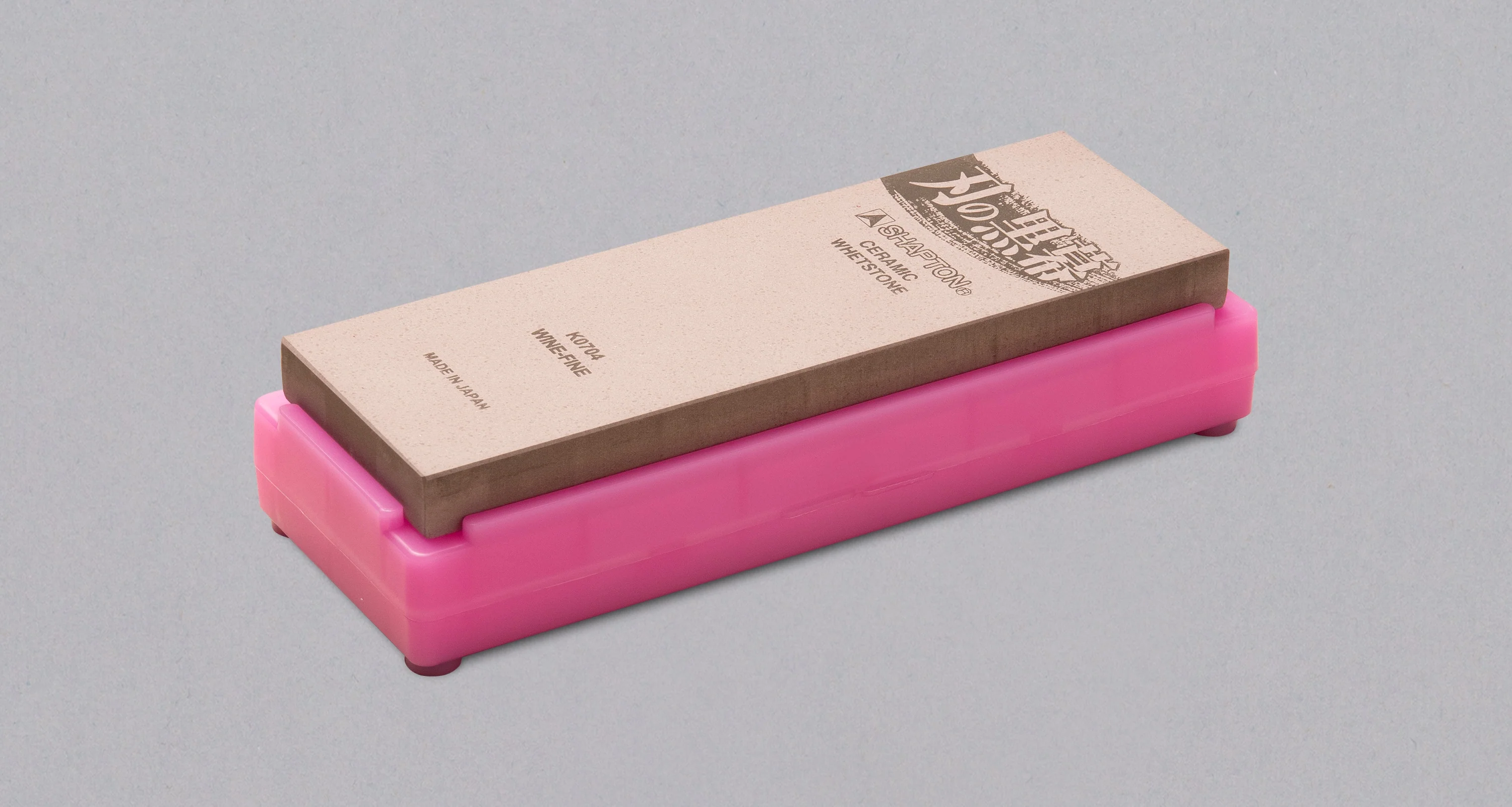
Shapton Kuromaku - #5000 [Wine]
Shapton’s Kuromaku sharpening stone series is a longtime favorite among chefs, knife sharpeners, and woodworking professionals. These high-performance Japanese waterstones are color-coded by grit level—from coarse reprofiling to ultra-fine polishing—making it easy to build an organized sharpening setup. Kuromaku stones are splash-and-go (no soaking needed), long-lasting, and suitable for sharpening knives, scissors, chisels, and other edged tools. Easy to use and fast-cutting, they’re ideal for both beginners and experienced sharpeners.
The included plastic storage case doubles as a sharpening base, providing extra stability while you work.
Why choose Shapton Kuromaku stones?
✔ Fast cutting speed and long-lasting performance
✔ Harder composition resists dishing and stays flatter, longer
✔ Compact and practical—ideal for home kitchens, workshops, or travel
The #5000 grit stone (Wine) is ideal for fine honing and polishing. It produces a smooth, refined edge that enhances both cutting performance and edge retention. It’s a great finishing stone for kitchen knives or tools that require a clean, sharp edge.
Whether you're fixing chips or putting the final polish on your favorite blade, there's a Kuromaku stone for every step!
Specifications:
Color: Wine
Product Number: K0704
Intended end-usage: Fine (#5000)
Dimensions: 210 x 70 x 15mm
Weight: approx. 500g
|
Shapton Stones – FAQ Do Shapton stones need to be soaked before use? Which side of the Shapton Kuromaku stone should I use? What types of blades can I sharpen with Shapton stones? Can I sharpen a knife with chips or a damaged edge? In what order should I use Shapton sharpening stones? Does a buildup of slurry create any problems when sharpening? Which Shapton stones are recommended for household knives? Why is my stone slipping or not cutting well anymore? My fine Kuromaku stone feels soft. What happened? Can I use sandpaper to flatten a Shapton stone? Is hot water safe for sharpening? I found some uneven color or spots on the surface of my new Shapton stone. Is that a defect? |
Shapton’s Kuromaku sharpening stone series is a longtime favorite among chefs, knife sharpeners, and woodworking professionals. These high-performance Japanese waterstones are color-coded by grit level—from coarse reprofiling to ultra-fine polishing—making it easy to build an organized sharpening setup. Kuromaku stones are splash-and-go (no soaking needed), long-lasting, and suitable for sharpening knives, scissors, chisels, and other edged tools. Easy to use and fast-cutting, they’re ideal for both beginners and experienced sharpeners.
The included plastic storage case doubles as a sharpening base, providing extra stability while you work.
Why choose Shapton Kuromaku stones?
✔ Fast cutting speed and long-lasting performance
✔ Harder composition resists dishing and stays flatter, longer
✔ Compact and practical—ideal for home kitchens, workshops, or travel
The #5000 grit stone (Wine) is ideal for fine honing and polishing. It produces a smooth, refined edge that enhances both cutting performance and edge retention. It’s a great finishing stone for kitchen knives or tools that require a clean, sharp edge.
Whether you're fixing chips or putting the final polish on your favorite blade, there's a Kuromaku stone for every step!
Specifications:
Color: Wine
Product Number: K0704
Intended end-usage: Fine (#5000)
Dimensions: 210 x 70 x 15mm
Weight: approx. 500g
|
Shapton Stones – FAQ Do Shapton stones need to be soaked before use? Which side of the Shapton Kuromaku stone should I use? What types of blades can I sharpen with Shapton stones? Can I sharpen a knife with chips or a damaged edge? In what order should I use Shapton sharpening stones? Does a buildup of slurry create any problems when sharpening? Which Shapton stones are recommended for household knives? Why is my stone slipping or not cutting well anymore? My fine Kuromaku stone feels soft. What happened? Can I use sandpaper to flatten a Shapton stone? Is hot water safe for sharpening? I found some uneven color or spots on the surface of my new Shapton stone. Is that a defect? |
Original: $75.00
-70%$75.00
$22.50Description
Shapton’s Kuromaku sharpening stone series is a longtime favorite among chefs, knife sharpeners, and woodworking professionals. These high-performance Japanese waterstones are color-coded by grit level—from coarse reprofiling to ultra-fine polishing—making it easy to build an organized sharpening setup. Kuromaku stones are splash-and-go (no soaking needed), long-lasting, and suitable for sharpening knives, scissors, chisels, and other edged tools. Easy to use and fast-cutting, they’re ideal for both beginners and experienced sharpeners.
The included plastic storage case doubles as a sharpening base, providing extra stability while you work.
Why choose Shapton Kuromaku stones?
✔ Fast cutting speed and long-lasting performance
✔ Harder composition resists dishing and stays flatter, longer
✔ Compact and practical—ideal for home kitchens, workshops, or travel
The #5000 grit stone (Wine) is ideal for fine honing and polishing. It produces a smooth, refined edge that enhances both cutting performance and edge retention. It’s a great finishing stone for kitchen knives or tools that require a clean, sharp edge.
Whether you're fixing chips or putting the final polish on your favorite blade, there's a Kuromaku stone for every step!
Specifications:
Color: Wine
Product Number: K0704
Intended end-usage: Fine (#5000)
Dimensions: 210 x 70 x 15mm
Weight: approx. 500g
|
Shapton Stones – FAQ Do Shapton stones need to be soaked before use? Which side of the Shapton Kuromaku stone should I use? What types of blades can I sharpen with Shapton stones? Can I sharpen a knife with chips or a damaged edge? In what order should I use Shapton sharpening stones? Does a buildup of slurry create any problems when sharpening? Which Shapton stones are recommended for household knives? Why is my stone slipping or not cutting well anymore? My fine Kuromaku stone feels soft. What happened? Can I use sandpaper to flatten a Shapton stone? Is hot water safe for sharpening? I found some uneven color or spots on the surface of my new Shapton stone. Is that a defect? |